

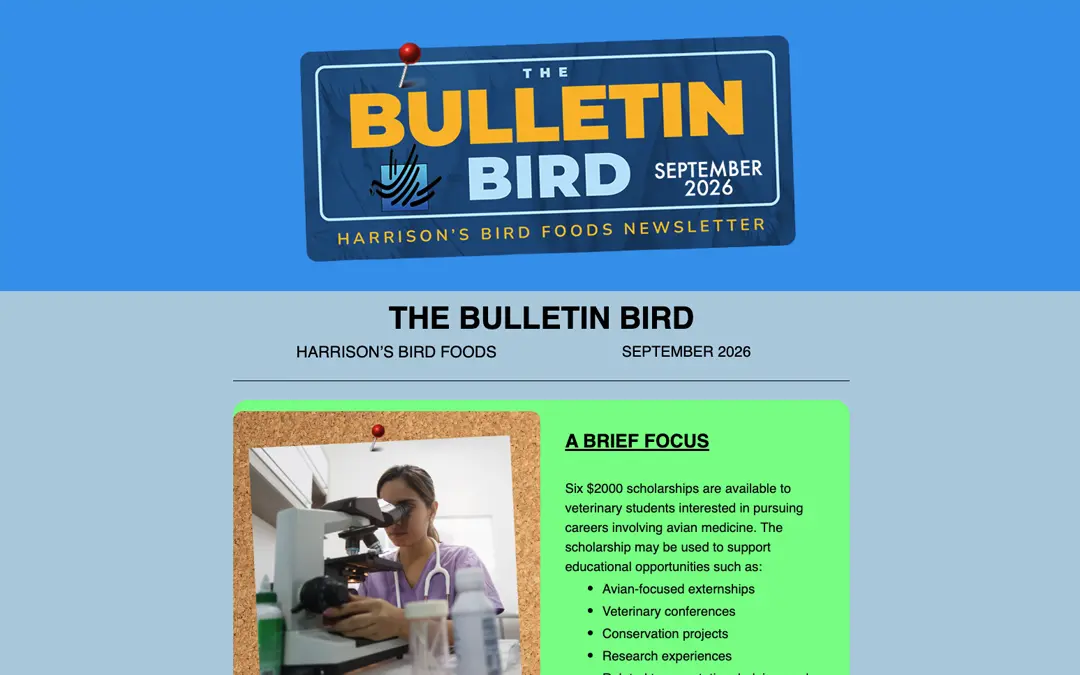
A Brief Focus
Six $2000 scholarships are available to veterinary students interested in pursuing careers involving avian medicine. The scholarship may be used to support educational opportunities such as:
- Avian-focused externships
- Veterinary conferences
- Conservation projects
- Research experiences
- Related transportation, lodging, and registration expenses
Behind the Scenes
The Foundations of Avian Medicine and Nutrition Virtual Symposium on September 18 attracted 138 participants from 17 countries. Speakers included moderator Dr. Donald Brightsmith from the Macaw Society and Texas A&M University and Drs. Stephen Fronfield, Liz Koutsos, Tia Greenberg, and Jonathan Stockman as well as Jason Rokey, who procures the organic ingredients for Harrison’s Bird Foods.
You May Not Know
Dr. Jan Hooimeijer offers educational seminars and workshops focused on parrot welfare, behavior, health, and responsible handling. These programs are valuable for veterinary professionals, students, bird owners, breeders, rescues, and zoos. For more information, contact info@janhooimeijer.nl or visit www.janhooimeijer.nl
Recipes
Bird Bread from Food Crumbs
Dipl.-Stat. (Univ.) Monika Janeczek e.K.
Avifood
Crumbly or powdery food in a bag of Harrison’s High Potency or Adult Lifetime Coarse occurs naturally during production and cannot be avoided for technical reasons. This food is exactly the same high quality as the other food in the bag, but sometimes parrots do not like to eat crumbly or powdery food in this form.
An Interesting Tidbit
Avian Anatomy Posters
Just a reminder that avian anatomy posters are available for framing and displaying.
Harrison’s Bird Foods full veterinary anatomy poster with multiple breakouts.
18″ x 24″ full color illustrations.
Toxin Alert
The Environmental Working Group (ewg.org) took a closer look at the menus from 12 of the top fast-food spots in the U.S. to help families on the go find less processed options. It wasn’t a comprehensive look at all fast food, but it does suggest that some chains are better than others when it comes to ultra-processed food…
Customer Spotlight
Feifei
This little one is quite a picky eater. As his mom, I’ve always worried about whether he’s eating well enough or getting balanced nutrition. So I kept trying different kinds of pellets, hoping to find one he would truly accept—and that would give me peace of mind. Then we met Harrison’s…
Distributor Focus
Urban Parrot Loft
By Carole Lay
Urban Parrot Loft was established in 2012 with a singular, uncompromised mission: To elevate avian healthcare standards and bring the world’s finest nutrition to companion birds.
Deeply rooted in Hong Kong for over a decade, we have built an enduring bridge of trust between bird guardians and breeders. Over the past 14 years, we have grown from a passionate avian care advocate into the region’s most trusted partner in premium parrot care, proudly upholding the strict quality standards of Harrison’s Bird Foods…
Species Focus
Hawk-headed Parrot
How to Live with Your Hawk-headed Parrot: Hawk-headed parrots, also known as red-fan parrots, are not particularly common in aviculture but are sometimes kept as aviary birds or companion parrots. They are known for having a bold, complex, and sometimes unpredictable or territorial personality…
$5 Off Your Next Harrison’s Bird Foods Purchase
$5 off any order over $25 or more excluding shipping charges.
Please use code 5off25 at checkout.
One time use.
Retail sales only.
Offer valid until October 23, 2026.
A Brief Focus
Six $2,000 scholarships are available to veterinary students interested in pursuing careers in avian medicine. The scholarship may be used to support educational opportunities such as:
- Avian-focused externships
- Veterinary conferences
- Conservation projects
- Research experiences
- Related transportation, lodging, and registration expenses
International applications are welcome from students in their final two years of study. Applications must include a completed application form, proof of enrollment, a résumé, two letters of recommendation, and a student photo with a brief bio. Submit materials to Kaitlyn Nikirk, DVM, at nikirk.dvm@gmail.com by November 15, 2026.
Recipes
Bird Bread from Food Crumbs
Dipl.-Stat. (Univ.) Monika Janeczek e.K.
Avifood
Crumbly or powdery food in a bag of Harrison’s High Potency or Adult Lifetime Coarse occurs naturally during production and cannot be avoided for technical reasons. This food is exactly the same high quality as the other food in the bag, but sometimes parrots do not like to eat crumbly or powdery food in this form. The following recipe for baking bird bread allows the crumbs to be used in a tasty form, and as any bird bread, is an ideal training treat or reward. It also offers supplementary protein during the molting or breeding season, as new feathers consist largely of protein and egg-laying females and rapidly growing young birds require a considerable amount of protein.
Option 1: Harrison´s Juvenile and Spicy High Potency Fine
- up to 200 g of crumbly to powdered feed
- 2 bags of Harrison´s Juvenile Formula (450 g)
- 1 bag of Harrison´s Spicy High Potency Fine (450 g)
- 12 organic eggs
- 90 ml liquid coconut oil, certified organic
- 1 – 2 tbsp coconut flakes, certified organic
- Optional: 1 grated apple or 2 grated carrots, certified organic
- 3.5 tsp (16 g) of organic baking powder
- Approx. 1200 to 1300 ml water
Thoroughly mix all ingredients and spread evenly on a baking tray lined with parchment paper. Bake in the oven at 180°C (350°F) for 30–35 minutes. Leave to cool completely, then cut into small cubes. Freeze in airtight freezer bags or plastic containers; it will keep for up to 12 months. Before feeding, take the required number of cubes out of the freezer and leave them to thaw briefly at room temperature.
Option 2
Use 1 bag each of Juvenile Formula, Recovery Formula and Spicy High Potency Fine along with the other ingredients listed and slightly reduce the amount of water, although the dough must be spreadable.
Toxin Alert
The Environmental Working Group (ewg.org) took a closer look at the menus from 12 of the top fast-food spots in the U.S. to help families on the go find less processed options. It wasn’t a comprehensive look at all fast food, but it does suggest that some chains are better than others when it comes to ultra-processed food.
There was one surprising standout: Chipotle’s food menu contains no ultra-processed ingredients. Every menu item at Chipotle is made from some combination of 53 total ingredients, including the flour used to make tortillas, vegetables for guacamole and salsa, and seasonings to prepare beans, rice, meat and poultry. It also includes the rennet and cultures used to make cheese. (There are still some caveats regarding sodium and saturated fat.)
At most other fast-food restaurants, it’s harder to find a meal that isn’t ultra-processed. That’s because industrial ingredients are a cheap way to mass produce flavorful foods with long shelf lives. They also help create consistency, the reason a Big Mac in Los Angeles tastes the same as a Big Mac in Kansas City.
Customer Spotlight
Feifei
This little one is quite a picky eater. As his mom, I’ve always worried about whether he’s eating well enough or getting balanced nutrition. So I kept trying different kinds of pellets, hoping to find one he would truly accept and that would give me peace of mind.
Then we met Harrison’s. That day, he finally opened his beak, one bite after another, without hesitation. It felt as if he was telling me, “This one, I like.” From that moment on, Harrison’s became his favorite, and an essential part of his daily life. When mealtime comes around, he waits patiently, finishing the entire bowl with care and focus. Watching him eat with such contentment, I can’t help but feel relieved. Harrison’s isn’t just his favorite food, it’s also the reason I feel at ease.
– Courtesy of ZERO
Distributor Focus
Urban Parrot Loft
By Carole Lay
Urban Parrot Loft was established in 2012 with a singular, uncompromised mission: To elevate avian healthcare standards and bring the world’s finest nutrition to companion birds.
Deeply rooted in Hong Kong for over a decade, we have built an enduring bridge of trust between bird guardians and breeders. Over the past 14 years, we have grown from a passionate avian care advocate into the region’s most trusted partner in premium parrot care, proudly upholding the strict quality standards of Harrison’s Bird Foods.
What Makes Urban Parrot Loft Unique?
We don’t just distribute Harrison’s. We live it! From our hand-reared baby caiques nurtured on Juvenile Formula to our thriving adult parrots, such as these rare Tres Marias Amazons hand-reared by us from the second week on Harrison’s Juvenile Formula and thriving in magnificent condition on High Potency nuggets, our birds are the living, vibrant proof of Harrison’s superior nutrition where pure, certified organic ingredients, zero chemical preservatives, and strict quality standards matter most.
The demand is so extraordinary that whenever fresh shipments arrive, customers don’t just buy bags, they bring literal suitcases to our flagship store to stock up on Harrison’s!
To protect our avian community from counterfeit risks, we are proud to be a global pioneer in implementing Harrison’s state-of-the-art, high-security, anti-counterfeit labels on every authorized package in our region.
Our magnificent red-tailed black cockatoo (Banksii) in our store, the exact species that inspired the Urban Parrot Loft logo!
Species Focus
Hawk-headed Parrot
How to Live with Your Hawk-headed Parrot
Hawk-headed parrots, also known as red-fan parrots, are not particularly common in aviculture but are sometimes kept as aviary birds or companion parrots. They are known for having a bold, complex, and sometimes unpredictable or territorial personality.
While juvenile birds tend to be docile, adults can be particularly ill-tempered, stubborn, unpredictable and strong-willed birds, showing extreme aggression towards humans and other birds housed with them (including others of their own species and/or their own mates), particularly when in breeding condition. Hawk-headed parrots, when kept as pets, tend to bond with one person and require firm handling and a patient owner, experienced in both bird-keeping and the reading of parrot body language. However, as with all parrots, temperament can vary greatly from individual to individual and some hawk-headed parrots make excellent companions.
What to Know About Your Hawk-headed Parrot
Native to the Amazon Basin and surrounding lowland tropical rainforests in countries like Brazil, Venezuela, Colombia, Ecuador, and the Guianas, they are smaller than most Amazons, measuring 12-14 inches long and weighing 7-10 ounces (200 to 280 grams).
Hawk-headed parrots are intelligent and creative, with the ability to solve puzzles when foraging for their food. In the wild they eat guavas, Inga fruits, berries, seeds, nuts, buds and leaves. In captivity, they eat pellets and a variety of fresh fruits and vegetables.
Male hawk-headed parrots will defend their territory, and both males and females can be aggressive and unpredictable. When they feel threatened or alarmed, they will raise their nape feathers to form a fan, appearing much larger and more threatening than before.
Is Your Hawk-headed Parrot a Boy or Girl?
Males and females are sexually monomorphic (look identical); therefore, surgical or laboratory means must be used for gender identification.