

How to Live with a Cape Parrot
With their expressive faces, inquisitive nature and surprisingly powerful beaks, these African parrots are fascinating birds to observe. They enjoy investigating new objects, dismantling branches and working out how to reach a favourite treat. But their intelligence also means that life in a small cage, without exercise or stimulation, is not enough.
An important distinction comes first: the true Cape parrot (Poicephalus robustus) is a rare, Vulnerable species. It should not be promoted as a pet; responsible, genetically managed breeding and conservation should take priority. Its close relatives, the brown-necked and grey-headed parrots, are more familiar to companion bird owners, although they too need experienced, committed care.
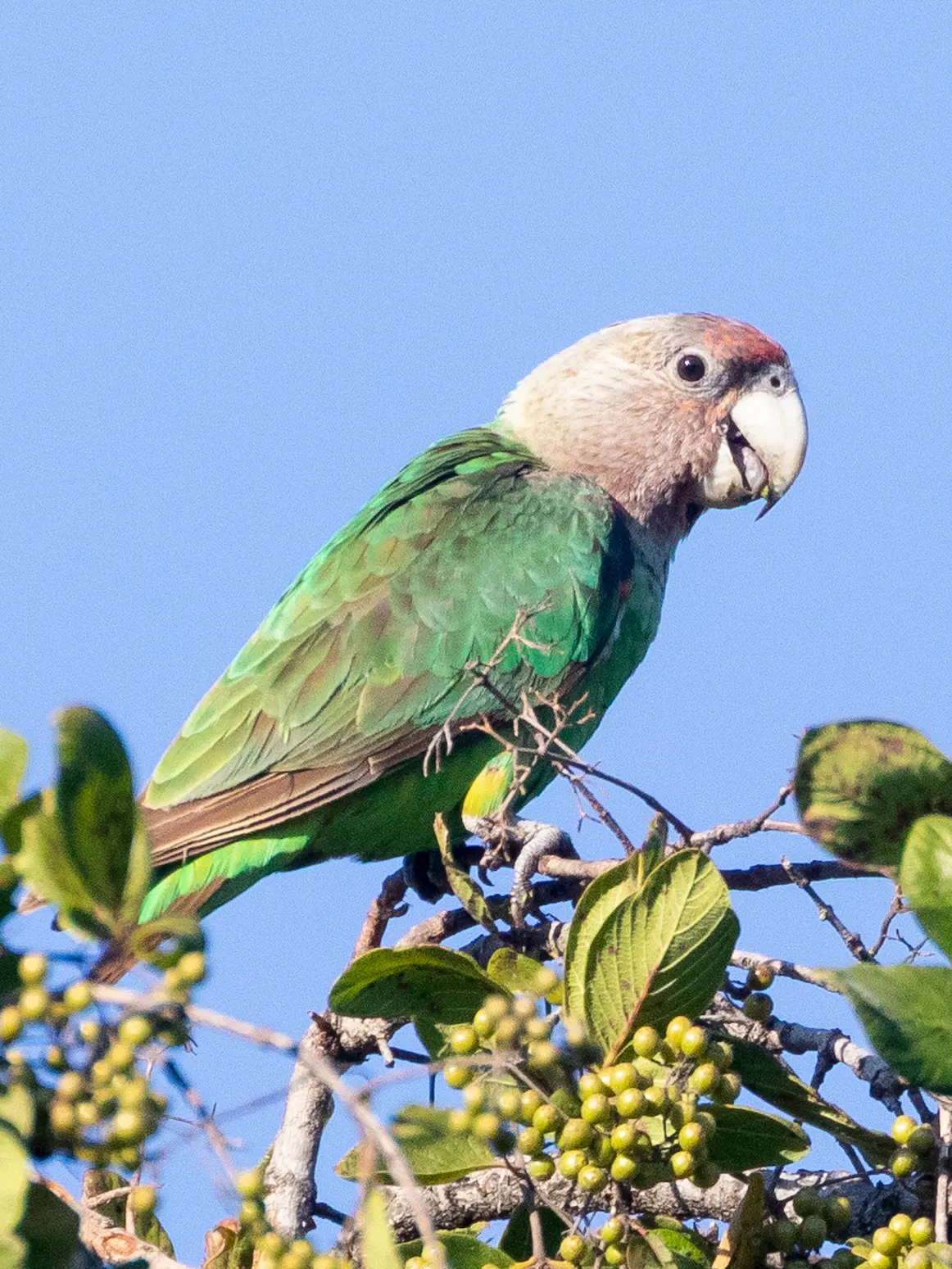
What to Know About Your Cape Parrot
Not every bird called a “Cape parrot” is actually one. The group was once treated as a single species with three subspecies. Today, the true Cape parrot is recognized as P. robustus, while the other two forms belong to P. fuscicollis. This matters especially in the United States, where grey-headed parrots are relatively common in aviculture and may still be sold or described as Cape parrots.
True Cape parrot — P. robustus (Vulnerable, VU). Found only in South Africa, particularly in indigenous Afromontane forests. Look for the characteristic olive-yellow to golden-brown head and neck. Indicative adult weight: 250–400 g.
Brown-necked parrot — P. fuscicollis fuscicollis (Least Concern, LC). Native to West Africa, with a brownish-grey head and neck above its green body. Indicative adult weight: 250–350 g.
Grey-headed parrot — P. fuscicollis suahelicus (Least Concern, LC). Found across parts of south-central and southeastern Africa. Its silver-grey head and neck are striking against the green plumage. Indicative adult weight: 300–400 g.
These weight ranges overlap and are guides, not identification tests. The LC conservation assessment applies to P. fuscicollis as a species, including its two subspecies.
Is Your Cape Parrot a Boy or Girl?
Here is a useful clue for owners: look at the forehead—but consider the bird’s age. Adult female P. robustus usually show a small orange-red forehead patch, while adult males generally lack it. In both the brown-necked and grey-headed parrots, adult females typically show a larger, more conspicuous orange-red patch; adult males generally do not.
Young males can also have a small orange-red patch, which usually disappears after their first moult. A colourful forehead in a young bird therefore does not prove it is female. For certainty, especially when selecting breeding partners, use DNA sex determination.
How to Keep Your Cape Parrot Happy
Think beyond the cage. Brown-necked and Grey-headed companion parrots need a generous, well-equipped enclosure and regular opportunities to fly in a bird-safe room. Appropriately trained outdoor flight is an option only where it can be done safely. Offer natural perches, safe chewing branches, simple foraging puzzles and opportunities for appropriate social contact. Rotate activities to keep their busy minds engaged.
Choose a bright, airy location with shade available—not constant direct sun. Safe fresh air, natural sunlight and chances to bathe or enjoy gentle rain can benefit their condition, provided they can always retreat to shelter. Equally important is a quiet, secure place for uninterrupted sleep; a busy living room late into the evening is rarely an ideal sleeping area. Keep birds away from smoke, sprays, fumes and overheated non-stick cookware.
Food should match the bird’s lifestyle. In our spacious flight aviaries, breeding P. robustus receive a Harrison’s-based ration: Adult Lifetime Coarse only during the complete resting period, and High Potency Coarse during moulting, breeding preparation, breeding and chick-rearing. Fresh vegetables and carefully limited extras complement the formulated diet. We typically offer total food equivalent to around 7-9% of body weight daily to these active breeding birds; this is food offered, not necessarily consumed, and fresh-food moisture affects the calculation.
Do not transfer that allowance directly to a pet bird. A companion parrot that flies less may need a different ration. Discuss portions, body condition, exercise, safe outdoor access and individual health with an avian veterinarian.
For readers who would like more detail: The separate downloadable Cape Parrot Care and Feeding Guide covers practical housing, diet, rest, exercise and household hazards. A second, independent Complete Cape Parrot Breeding Report is available for those interested in breeding management and chick-rearing.
