

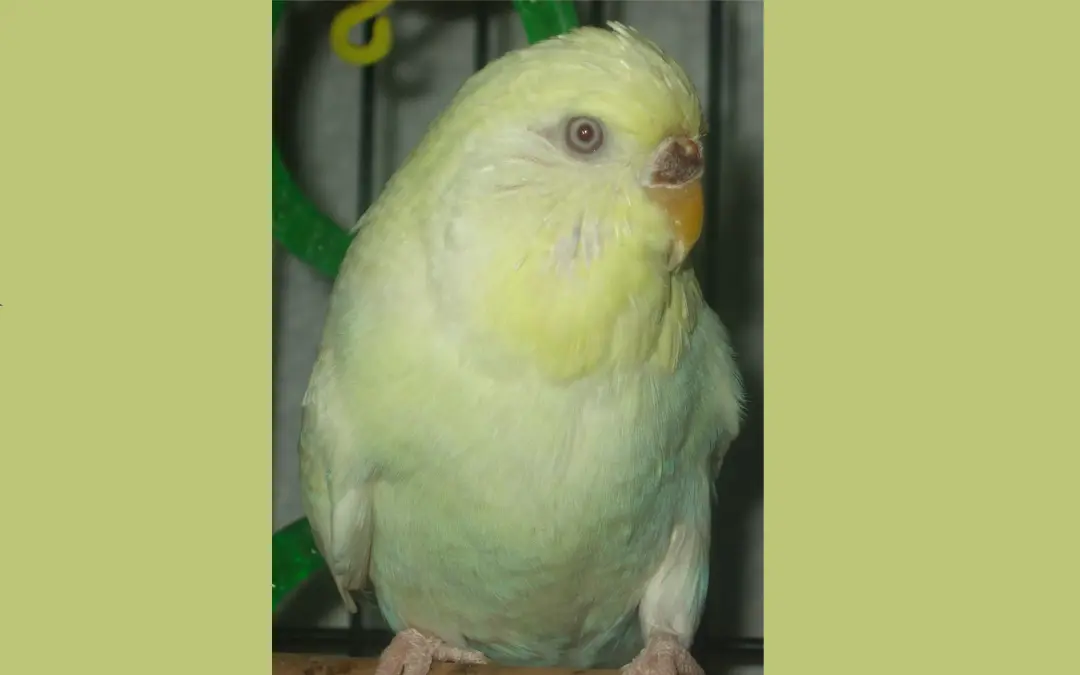
Before we start, I just want to point out that I am not an avian vet, this is just relevant information & includes my experiences with helping residents with rickets. Some rickets symptoms are also seen in other conditions, if you are at all concerned, please seek advice from your avian vet. As you may know, my new residents Maud & Hedwig have rickets, Hedwig is pictured here & will be the focus of this article as it impacts her more severely.
SIGNS & SYMPTOMS – These can vary from Bird to Bird & between different species, however the most common ones are: reduction in weight, soft bones, perching squatted down (resting tummy on perch constantly instead of being ‘up on their legs’), lameness, slow or poor growth if the Bird is a baby & the beak can sometimes be soft too. Hedwig’s leg bones are extremely soft & she really struggles with moving. Take a look at her picture below, can you see her odd posture & how she is leaning to one side? This is because, although both her legs are affected, the leg that appears lower down is far softer & struggles to support her weight. This results in the odd leaning posture you can see here. It’s hard to believe she is 2 years old.
POTENTIAL CAUSES – A deficiency of calcium or vitamin- D are obvious causes, but solving which came first can be a puzzle. Because they are supporting nutrients (they need each other to help the body work) a deficiency in one can lead to a deficiency in another because without the first nutrient, the other struggles to be absorbed. At first, supplementation of calcium & vitamin- D can help both levels, but in the long term we need to know which they were not accessing enough of in their daily life so we can correct that & they have access naturally. Sometimes it can also be down to issues with the oil gland. Some Bird species have a gland at the base of the tail that produces preen oil. This preen oil helps to condition & waterproof the feathers, but also contains the precursor of vitamin D. After preening the oil onto their feathers, it is exposed to UVB light. When they preen again, they ingest the UVB exposed oil, which is now pre-Vitamin-D & it becomes converted into vitamin-D3 by the Bird’s liver. If their oil gland is blocked, or not producing oil, this process of course doesn’t work & they will become deficient in vitamin- D no matter how much sunlight or Bird UV lamp exposure they get.
FORTIFIED PRODUCTS – It is important to remember than any human supplement or human food fortified with Vitamin D is in completely the wrong level for a Bird & should be avoided entirely. Some Bird seed mixes have ‘fortified with vitamin D’ proudly emblazoned all over the packaging, but which part is fortified? The husk, which they take off & leave in the bowl! Maud & Hedwig were on such a seed mix but still ended up with severe rickets. They are to help owners part with their money rather than help the Bird sadly.
TREATMENT – This is an area I am not comfortable to go into detail with as it can vary significantly from case to case. Calcium & vitamin D supplementation may be required, but shouldn’t replace avian vet input. Increase in calcium rich foods (dairy is not suitable & doesn’t fix calcium deficiency in most Birds. dairy is harmful to Birds because they are not mammals!) like leafy greens, broccoli, sesame seeds, pulses etc. &/or the addition of more sunlight access or an avian UV lamp may be suggested. Other things must be ruled out & severity determined, so if you recognize any issues raised here, please see your vet as soon as you can.
PREVENTION – People may be surprised, but rickets is not rare in pet Birds. I have had many residents with it before & all have been in severe stages as previous owners didn’t notice the signs. There are certain things we can do as owners that will help prevent the development of rickets in our precious Birds.
EXPOSURE TO UVB – access to natural sunlight (not through a window) is the best source of vitamin D, as nature intended. Supervised outside time with the Bird safe in a travel cage on a regular basis will offer plenty of UVB. If this isn’t possible, avian specific UV lamps that stand near or clip to the cage are available from avian specialist shops & online stores.
GOOD NUTRITION – a healthy diet free of human/junk/table food & drinks is the most important thing to maintain good health in our Birds. Healthy food is not depriving them of fun; it is sparing them from disease. Good nutrition can be fun, exciting, enriching & brimming with delicious flavors, colors & textures. Variety is important, but variety of the right kinds of food. Plant sources of calcium are what a Bird’s body recognizes & absorbs best, that is how they evolved to eat. Resist the urge to give dairy, it is the wrong food entirely for their digestive system. One of my African greys came to me because his calcium levels were so severely low that he had seizures & was a severe plucker, the previous owner didn’t know why because he had dairy every day. After a week eating dark leafy greens, his fits stopped!
REGULAR HEALTH CHECKS – Learn how to health check your Bird & ensure that their oil gland (if present in that species) is working well & any other important health signs. If even the tiniest thing concerns you, your avian vet is there to guide you with what to do next.
Rickets impacts the lives of a surprising amount of pet Birds & a lot more awareness is needed. Did you find this article helpful? If so, please consider sharing it & help spread the word. Thank you.