

Why it Matters
Proper husbandry of any species is crucial for ensuring healthy, well-adjusted pets. The closer we come to recreating the conditions of the species in the wild combined with the benefits of modern science, the more likely the animals are to not merely survive but also thrive.
While we have made enormous strides in avian nutrition over the past 40 years with the advent of formulated diets, little attention has been paid to the role that sunlight plays in metabolism and behavior. Many of our pet birds are hatched and live their entire lives indoors with no exposure to UVB lighting or the sun.
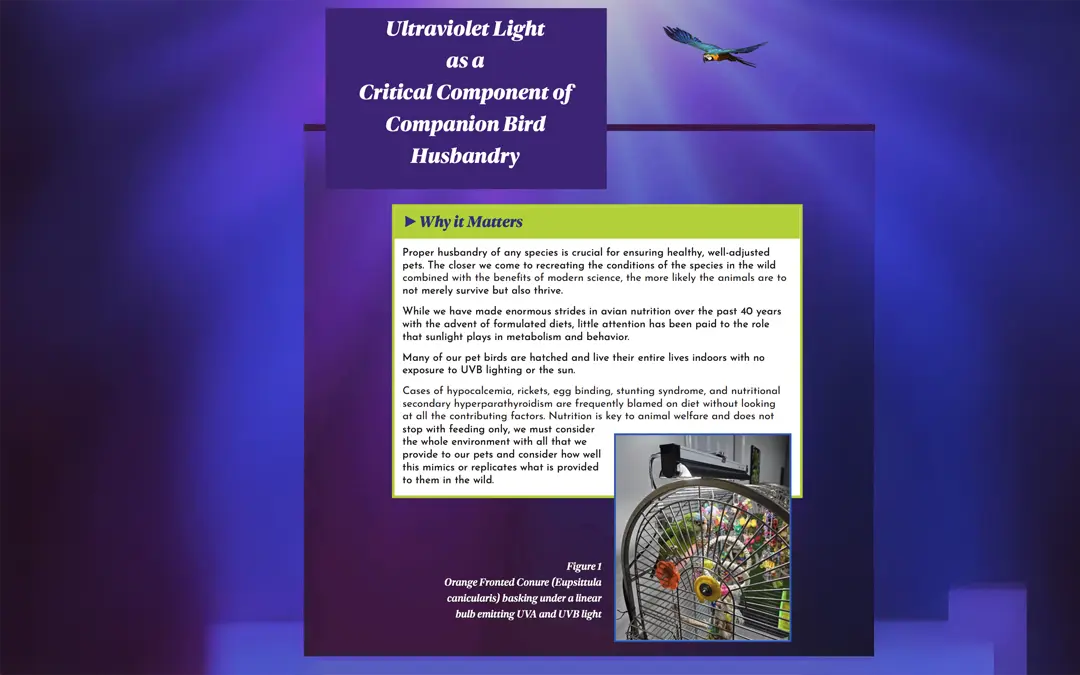
Cases of hypocalcemia, rickets, egg binding, stunting syndrome, and nutritional secondary hyperparathyroidism are frequently blamed on diet without looking at all the contributing factors. Nutrition is key to animal welfare and does not stop with feeding only, we must consider the whole environment with all that we provide to our pets and consider how well this mimics or replicates what is provided to them in the wild.
How it Works
Birds rely on both dietary intake and cutaneous absorption to maintain adequate Vitamin D levels.
Most birds possess a uropygial gland found at the base of the tail, which aids in the endogenous synthesis of Vitamin D³ when exposed to sunlight (UVB). The secretion of this gland contains Vitamin D precursors (7-dehydrocholesterol), which are converted to the active form of Vitamin D³ when exposed to ultraviolet light (either sunlight or UVB) and warmth. During subsequent preening, this active form of Vitamin D³ is ingested by the bird.
Avian epidermal cells undergo both lipogenesis and keratinization and have been called “sebokeratinocytes”. The skin acts as a sebaceous secretory organ, with the sebum serving as a moisture barrier and helping maintain the pliability of the keratinized epidermis. Birds secrete 7-dehydrocholesterol onto featherless areas of skin with 30x more 7-dehydrocholesterol on the featherless leg skin than on the back. It is worth noting that several species of pet birds, such as African Greys and Macaws, have bare facial patches which may allow for more direct exposure to UVB. This explains how species that lack a uropygial gland can still maintain water resistance in the feathers and can produce precursors to Vitamin D³.
The process of converting precursors to active Vitamin D is so effective that it has been shown that poultry have NO dietary requirement for Vitamin D³ if they are supplied with adequate UVB radiation.
Relationship to Diet
The addition of a UVB light-producing source appears to have at least some benefit independent of diet.
In a study by Stanford utilizing African Grey Parrots, the provision of a pellet diet with an increased Vitamin D³ and calcium content significantly increased the plasma concentration of ionized calcium and 25 hydroxycholecalciferol over a seed-fed group. The addition of 12 hours daily of artificial ultraviolet radiation (UVB) significantly increased the ionized calcium concentration independent of the diet fed. Additionally, plasma 25 hydroxycholecalciferol (circulating D³) significantly increased in the seed group after the provision of UVB radiation.
This study concluded that the provision of adequate dietary calcium and D³, plus UVB radiation is essential for the prevention of disorders of calcium metabolism in captive African Grey Parrots.
In contrast to dietary sources of Vitamin D, hypervitaminosis D (“overdosing”) does not occur with solar or UVB exposure. UVB and short-length UVA convert excess Vitamin D into harmless by-products. This is known to be a self-regulated and recycling process.
Behavioral Changes of Birds Exposed to Sunlight
It has been observed that some male canaries that had stopped singing started to sing within hours of being provided with a UVB light.
A canary that has been kept indoors, when taken into the sun, will spread all the feathers of the wings into a parabola shape and tilt to follow the sun, exposing as much of the preen-oil-covered feathers as possible to the rays. This behavior is similar to the behavior of reptiles such as chameleons who will flatten out and turn towards the sun when basking to maximize exposure. Anecdotally, birds that are exposed to the sun will begin to preen vigorously and increase activity levels.
More than One Type of UV Light
In addition to the need for UVB light, birds utilize UVA light in many ways.
Birds possess a fourth ocular cell within the eye (tetrachromacy) that humans (trichromacy) do not possess. Humans can see around 1 million colors, but not deep blues into ultraviolet or high reds into infrared, whereas tetrachromates, such as birds, can see further into the blue spectrum and infrared, up to potentially 100 million colors.
This superior vision allows birds to see fluorescent markings on potential mates and predators that are invisible to our eyes. It has been shown that 72% of parrots have UV-reflective plumage. This explains how many of the monomorphic species can differentiate sex easily between pairs. The provision of full-spectrum+UVB lighting unveils fluorescent markers and enables birds to more easily pick partners and recognize their mates even within a flock.
UV also provides cues to food ripeness and in the case of raptors, urine trails left by rodents, but only in the presence of proper UVA lighting. It is reasonable to conclude that UVA light allows birds to see as they are meant to see the world. Any lighting solution we choose should therefore provide both UVA and UVB light in the correct proportions.
How Pet Owners Can Supply UVB
Placing a cage near a window or in a sunroom will not provide a benefit as most windows filter out the beneficial UVB and UVA rays. They do let infrared rays through, however, which is the reason cages placed near windows can easily overheat. There are essentially two ways to supply UV radiation to our pets:
- Natural Sun Exposure
Taking your bird outdoors 2 or 3 times a week for a 30-minute+ session (although any amount is beneficial).
- Supervision: Birds should always be caged, protected, and supervised. In addition to terrestrial predators (cats, rats, raccoons), raptors will readily strike a caged bird.
- Amenities: If the weather is warm, a bath can be offered to realize benefits to the feathers and skin in addition to UV. In any case, a dish for drinking water should be provided.
- Temperature Gradient: Create a gradient by partially covering or placing part of the cage in the shade so that the bird can escape overheating. Radiant heat can build up even when the air is cool. Direct sun is not strictly necessary as scatter reflection bounces off walls and cage bars; even cloudy days offer a benefit.
- Exposure to Artificial UVB (UVB fixtures and bulbs)
When adding artificial lighting sources, it is important to recognize that all bulbs are not equal. There are two primary configurations:
- Linear Bulbs: Linear UVB bulbs are superior to compact fluorescent bulbs because they cover a wider area of the body and produce more usable light. Among linear bulbs, you may encounter T8, T5, or T5HO (high output) bulbs. The T5HO bulb produces more than twice the amount of UVB radiation than the T8.
- Compact Fluorescent Bulbs: If a compact fluorescent bulb is the only option, the 3U lamp shape is more efficient than the pigtail shape, especially when used with a reflector. All types should be positioned horizontally to maximize downward light projection.
- LED Bulbs: There have been attempts to create LED UVB bulbs. Despite being labeled as “Full Spectrum”, it is currently impossible within physics to create LED solutions that can match the spectrum of the sun in UV, as T5 lamps do very well.
- Mercury Vapor Lamps: Mercury vapor lamps give off UVB but also substantial heat, making them unsuitable for pet bird cages.
Popular Bulbs Suitable for Birds
| Brand | Watts | UV-B | UV-A | Kelvin | Type | Heat |
| ZooMed Avian Sun Compact | 26W | 5% | Y | 6800K | 3U Lamp | No |
| ReptiSun 5.0 UVB T5HO-High Output | 15W | 5% | 30% | — | T5HO Linear Bulb | No |
| Arcadia Pure Sun Midi 22″ | 14W | 2.4% | 12% | 7000K | T5 Linear Bulb | No |
| Arcadia Pure Sun Mini 12″ | 8W | 2.4% | 12% | 5800K | T5 Linear Bulb | No |
| Arcadia Pure Sun Compact | 20W | 2.4% | 30% | 5800K | 3U Lamp | No |
| Arcadia T5 HO Linear 46″ | 54W | 2.4% | 30% | — | T5HO Linear | No |
| Hagen Exoterra UVB 100 Compact | 13W | “moderate” | Y | — | Pigtail Coil | No |
| Exo-Terra Reptile 5.0 Linear | 13W | “moderate” | Y | — | T5 Linear Bulb | No |
| Exo Terra SolarGlo | 160W | Not given | 30% | 4500K | Mercury Vapor | Yes |
| Flukers Sun Spot | 100W | Not given | Y | — | Mercury Vapor | Yes |
Export to Sheets
Setting Up the Lights
Several key factors greatly affect how much radiation reaches your bird. Keep these points in mind when setting up the enclosure:
- Reflectors: The use of a reflector can double the quantity of available light.
- Distance: Consistently maintain the distance from the bulb to the bird’s head according to manufacturer specifications. Electrical cords and components must remain completely out of reach of beaks and feet.
- Barriers: Physical barriers between the bulb and the bird reduce output. A bulb sitting directly on wire mesh can reduce the UV output by 30-50%.
- Age of Bulb: Most bulbs have a “burn-in” period of approximately the first 100 hours when they produce higher UV; they should be kept at a further distance during this time.
- Lifespan: Bulbs have a finite lifespan as the internal phosphors deplete. The bulb will continue to emit visible light long past the time that usable UVB is no longer being produced. It is recommended to replace a bulb when it produces less than 70% of its initial level of UV (some manufacturers recommend replacement after 6 months, others guarantee a year).
- Measurement: Ideally, measure the UV output with a Solarmeter 6.5 (or 6.5R) to verify the current UVB output and monitor for any manufacturing defects.
What Level of UV is Recommended?
There has been little research on what level of UV index is most beneficial for birds while also being safe; however, this has been extensively studied in reptiles.
If we consider many of our pet birds to be forest/temperate species (from areas of high solar activity but spending time in dappled sun and shade), a UV index (UVI) of 2-4 as measured by a Solarmeter 6.5 would be reasonable compared to reptiles from the same areas. There would logically be a need for a higher level of UVB for desert species such as cockatiels and budgerigars due to open exposure in their natural environment.
However, in the keeping of pet birds that are housed in the fixed, small environment of a cage, pending further research, a modest index would be prudent. In addition, the bird must have adequate space to escape the bulb and the ability to self-regulate exposure as they would in the wild.
Dr. Sheryl Calway of Oakmount Exotic Animal Medicine and Surgery Department (Oakmount Veterinary Hospital, part of IVC Evidensia) recommends that her avian patients have access to a UVI of 1-2 most of the day (10-12 hours), with bulbs always positioned overhead and other perches available entirely away from the bulb.
About the Author
Donna Garrou has kept and bred birds and reptiles for more than 30 years. She has been the chief surgical technician for 17 years at The BIRD Clinic avian-only practice in Orange, CA and is the developer of Kitty Kollar, the first esophageal tube protective collar for animals.
References
- Stephen J Birchard and Robert G. Sherding, 2006. Saunders manual of small animal practice. 3rd edition. St. Louis, MO: Saunders. 1888 p.
- Wrench, R., J. A. Hardy, and R. I. C. Spearman. 1980. Sebokeratocytes of avian epidermis with mammalian comparisons. In R. I. C. Spearman and P. A. Riley (eds.), The skin of vertebrates, pp. 47-56. Symp. Linn. Soc. Lond., No. 9. Academic Press, London.
- Michael Stanford. 2005. Calcium metabolism in grey parrots: the effects of husbandry. The Royal College of Veterinary Surgeons. Volume 2.
- John Courteney-Smith. 2018. The elements series, Part 1; Fire: the sun, its use and replication within reptile keeping. Cambridge, UK: Arcadia Reptile c/o Monkfield Nutrition. 201 p.
- Arcadia Bird website. 2024. Benefits of lighting.
- John Courteney-Smith. 2013. The Arcadia guide to MBD and its elimination in captivity. Cambridge, UK: Arcadia Products PLC. 111p.
- Sheryl Calway, BVMS, MRCVS, PgC (EAS), RCVS Advanced Practitioner in Zoological Medicine. 2024. Interpersonal correspondence via email between the author, Donna Garrou, and Dr. Calway. England, UK, Personal Email.
Husbandry information courtesy of: Harrison’s Bird Foods 7108 Crossroads Blvd. Suite 325, Brentwood, TN 37027 800-346-0269 | 615-221-9919 | www.harrisonsbirdfoods.com USDA Organic