

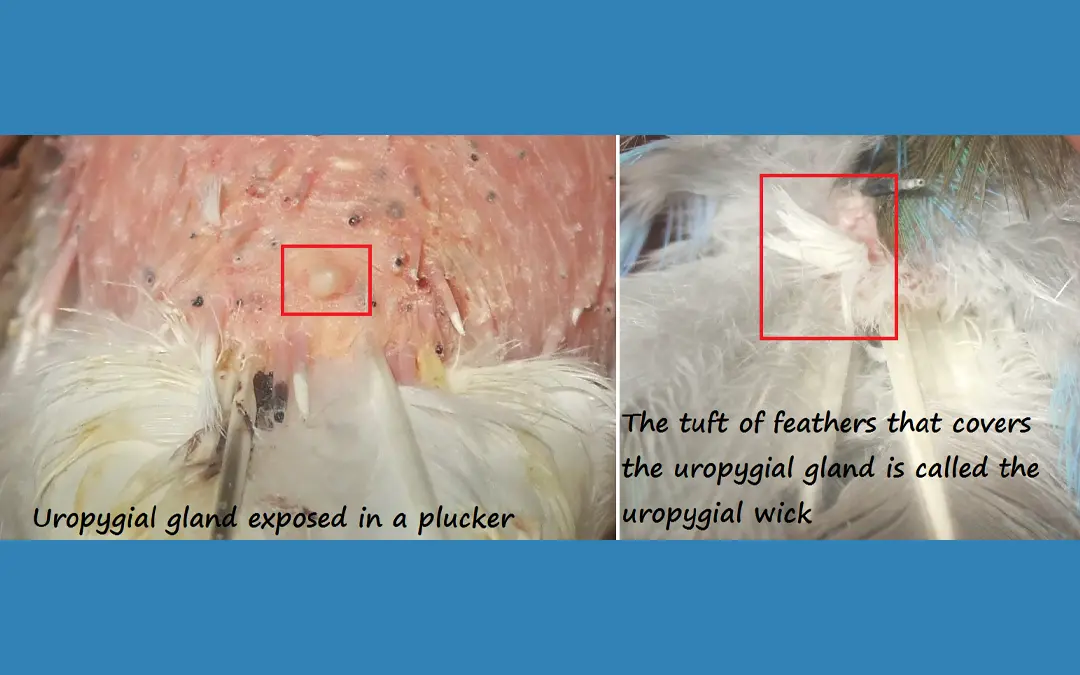
In this article, we will cover the basics of the uropygial gland, what its function is & why you should be checking that it’s healthy. Many species of Birds have a uropygial gland & owners can learn about the basics here, but it is absent in some species, such as Amazon Parrots & some species of Macaw & Dove.
WHAT IS IT?- The Uropygial gland is a bilobed structure at the base of a Bird’s tail, hidden underneath the feathers. Preen oil, a clear oily substance is secreted through the nipple-like structure, which is covered in a tuft of down feathers called the uropygial wick.
WHAT DOES IT DO?- The Uropygial gland secretes an oily sebaceous substance often termed preen oil. This preen oil plays a role in many important functions. Preen oil aids the waterproofing & conditioning of feathers, helps prevent skin from getting too dry, keeps the beak in good condition & perhaps most important of all, aids in the process of vitamin- D3 absorption. Preen oil contains vitamin- D precursors. When the oil is preened onto the feathers, it is exposed to ultraviolet light which converts the precursors to active vitamin- D3, which the Bird ingests when they preen. All of the functions of preen oil are essential.
WHY CHECK IT?- Like all parts of our Bird’s body, the uropygial gland can develop problems. Because the gland remains largely hidden, people often forget to check it (if they know their Bird has one at all) which means that problems go untreated until they are chronic or the Bird passes away. The most common concerns with the uropygial gland are blockage (when the gland gets blocked & the oil can’t come out) & infection.
HOW TO CHECK THE UROPYGIAL GLAND- Gently part the feathers at the base of the tail until you find the gland. Look for any redness or swelling of the gland or surrounding area. Gently touch the uropygial wick to see if there is any oily substance present. If there is any redness, swelling, lack of oil or anything that concerns you, please seek guidance from your avian vet. The earlier issues are ruled out or treated, the better chance the Bird has of recovering & being pain free. Your vet is there to help you. The Uropygial gland is a very delicate structure, make sure you don’t squeeze the gland or remove any of the surrounding feathers. Birds who have plucked feathers from the area of the uropygial gland are more likely to have poor oil production.