

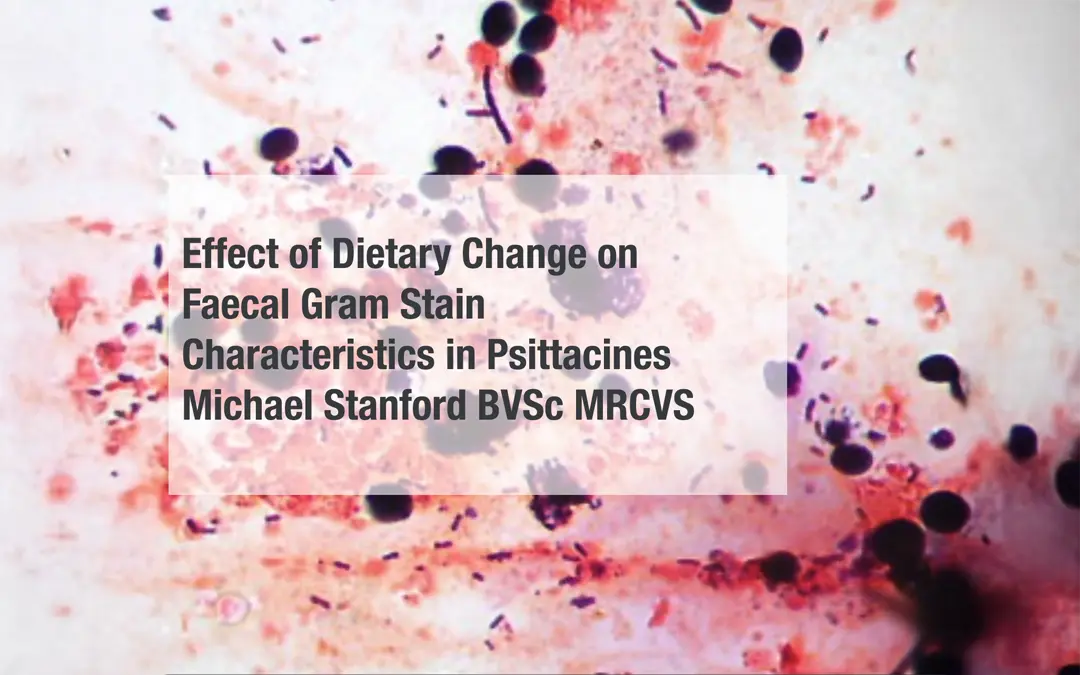
Michael Stanford BVSc MRCVS
Normal Faecal Microflora
- Mixed population of gram positive aerobes and anaerobes (Ref: Richie, Harrison and Harrison).
- Normal psittacine faeces would not be expected to have a gram negative population (Ref: Cheville).
- Confirmed on recent cockatoo cull in Australia (2002 personal communication).
Method
- 100 greys fed all seed diet for more than a year without supplements.
- 80 converted to pellets and 20 kept on seed based diet as a control.
- Gram stain taken every 4 weeks from 40 pellet fed birds and 20 seed fed greys.
- Same person responsible for making faecal smears as consistency is very important.
(Note: Slide includes visual references to HARRISONS HPC, SEED MIX USED, and CLIN-TECH reagents including Crystal Violet, Lugol’s Iodine, Gram’s Decolourizer, and Safranin O 1% Aqueous.)
Slide Reading
- One field of view
- % gram negatives : % gram positives
- Assessment of total number of bacteria in field.
- Yeasts
- Same microbiologist read all slides to reduce subjectivity
Results for Pellet Fed Greys
- Data tracked across weeks 0, 4, 8, and 12 of the project monitoring the number of birds presenting with Yeasts, Gram +, and Gram -.
Results for Control Seed Fed Group
- Data tracked across weeks 0, 4, 8, and 12 of the project monitoring the stable baseline of Yeasts, Gram +, and Gram – populations.
Comparison Between Seed Fed And Control Fed Group
- Graph displaying “% Normal Gram Stains” over Weeks 0, 4, 8, 12, and 52 comparing the SEED group vs. the PELLET group.
Practical Usage
- Cheap, effective yet non-invasive monitor of health.
- Any grossly abnormal gram stains would indicate need to investigate further.
- Useful in health checks and post purchase checks as a “lever” to encourage dietary change.
- Change of diet took several weeks to show in birds so monthly gram stain considered most useful.
Conclusion
- Converting grey parrots from seed based diet to pellet foods produced significant changes in the faecal gram stain characteristics.
- The changes were reflected by improved breeding performance and better performance in the pellet fed birds.
- Useful cheap tool for health checks and to encourage pet owners to convert their birds to better diets.
Thank You
- Harrisons Bird Foods for supplying pellet diet.
- RCVS Trust for financial assistance.
- Dave Bebbington for reading the smears.
- Becks Bird Barn for collecting samples.