



How to Live with a Pheasant
Pheasants are not traditional pets and are not recommended for those looking for a highly interactive or affectionate companion. While they can make stunning and rewarding pets for bird enthusiasts, they are ornamental and skittish rather than cuddly. They require large, predator-proof outdoor aviaries and a highly nutritious diet, and they thrive best when given plenty of natural space to roam rather than being kept indoors.
The enclosure should be a minimum of $6 \times 12$ feet per pair (though larger is better) to stay physically and mentally healthy. Aviaries should feature natural ground like grass, dirt, and hidden shrubs for dust bathing and foraging. Raccoons, skunks, dogs, and feral cats are the primary predators.
Pheasants are ground foragers and need a diet high in protein and essential minerals. Their diet consists of commercial game bird feed, supplemented with insects, berries, and seeds, and possibly mixed corn as a treat. Layer pellets may be too fatty and rich, particularly for the males. Most pheasants will happily eat bugs – either ones you find in your garden or mealworms and grubs from a pet store. Supplementary greens and fruit are also welcomed.
Potential adopters should also be prepared for the bird’s long lifespan and potential health needs.
What to Know About Your Pheasant
If you are new to keeping pheasants, it is highly recommended to start with docile and stunning exotic species rather than traditional game birds, as they are significantly easier to tame and manage.
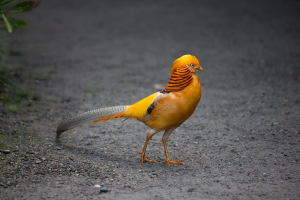
Golden pheasants are known as the best starter breed. They are extremely beautiful, with both the red golden and yellow golden varieties being calm and resilient. They also become very friendly relatively quickly – chirping for food, coming up to the dishes, and even eating from your hand.
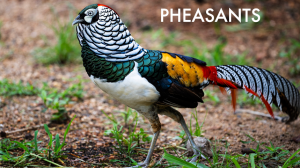
Lady Amherst pheasants are known for their striking colors and capes. They are fairly hardy and adapt quickly to aviary living; however, they may be elusive and scatty, running away and flying into the netting when approached.
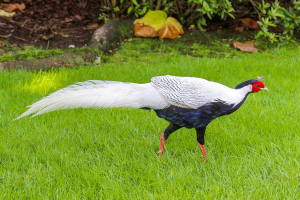
Silver pheasants are one of the few breeds that can be successfully free-ranged on an acre or two of property if hand-raised. Male silver pheasants can become friendly, often even displaying when the caretaker refills their bowls or walks by. The hens, however, can be rather flighty.
Reeves’s pheasants are available and inexpensive, but hens are scatty and males can become extremely aggressive. They grow super long spurs and will actively try to fly at you and scratch you. They are beautiful to look at, but never turn your back on a Reeves!
Is My Pheasant a Boy or Girl?
Male and female pheasants display striking physical differences. Males are larger, brilliantly colored with iridescent feathers and a bright red facial wattle, and have very long, pointed tail feathers. Females are smaller, muted brown for camouflage, and have much shorter tails.
How to Keep Your Pheasant Happy
Pheasants are not domesticated and prefer safety and space over human affection. They will not cuddle or sit on your shoulder like parrots. While skittish by nature, if you hand-raise them from chicks or spend lots of time socializing them, they can easily learn to eat treats right from your hand. When frightened, pheasants are known to take off vertically at high speeds. To prevent them from injuring their heads, the roof of their enclosure should be made of soft netting rather than rigid wire mesh.

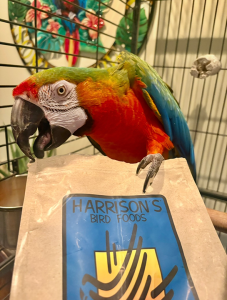
Lucky and Lola
A short story about my birds: my two large macaws – Lucky, a 26-year-old Blue and Gold, and Lola, a 5-year-old Catalina – are both rescues I took in over a year ago. Through a lot of time, patience, and training, they have come a very long way. I have even worked with an animal behaviorist, and through this, my birds’ lifestyle has completely improved.
I was able to convert the Blue and Gold Macaw to Harrison’s, but the Catalina was already on Harrison’s from the rescue center, Parrot Hope in Mantua, Ohio. They are the ones who suggested I use Harrison’s, as it is all-natural and they use it for all of their birds. My caique and Hahn’s macaw also enjoy Harrison’s and the Birdie Bread as well. I bought these two birds when they were young, so they grew up on Harrison’s, which made it very easy for me.
I frequently get comments on my birds’ feathering, color, and shine being in such good condition, and I feel their diet has a lot to do with this. We plan to build them an outdoor aviary this spring so they can get some fresh air and sunlight!
– Chera I.

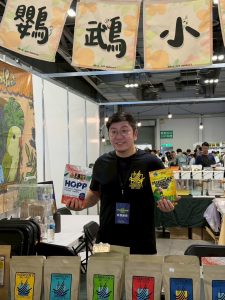
Observations from an HBD Distributor
By Tom Huang, Chief Executive Officer
ParrotsInc Asia Co., Ltd., Taiwan
Since my very first message to Dr. Greg Harrison on May 4, 2017, I have had the privilege of working with Harrison’s Bird Foods, and I now distribute Harrison’s products across Asia.
We have begun supporting rescue organizations in Taiwan through charitable donations. We are also in discussions to extend our support to the Taipei Public Zoo, with the goal of bringing Harrison’s commitment to avian welfare beyond the United States and into Asia – providing the highest level of nutritional care to birds across the region.

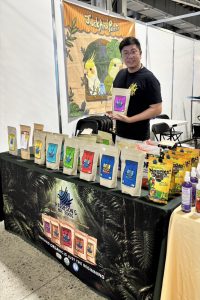
In addition, we are regularly invited to veterinary departments at universities in Taiwan, major pet exhibitions, and schools to provide free ornithological education to the public and to children. We strongly believe that education is the foundation of progress, and we are committed to continuing these free educational initiatives throughout Asia.
I have also participated in symposiums supported by Harrison’s to stay up to date with the latest advancements in avian nutrition. Through these experiences, I help educate pet shop owners on the importance of providing birds with optimal nutrition. In July, we met with Harrison’s distributor from Japan, where we had a chance to promote Booster Concentrate.
At the end of July, we will proudly open the first Harrison’s flagship store in Taiwan – and in Asia. We plan to organize charitable adoption events and establish regular educational programs to help bird owners stay informed about the latest care practices. We will also offer hands-on courses, such as making bird-safe cookies using Harrison’s bread mix.
It is truly my pleasure to work with Harrison’s. Looking ahead, our goal is to continue expanding education across Asia, helping bird owners and pet professionals gain the knowledge needed to care for every bird properly. Certified organic nutrition is only the beginning [ we remain committed to improving the overall standards of bird care throughout Asia.